Switzerland in Winter - An Ambassador, a Fog Line, and Not Much Snow
The first thing we saw in Interlaken was Yash Chopra.
Not a poster, not a film still. A bronze statue of him in a park, leaning against a vintage film camera on a tripod, cap on, one hand in his pocket, looking off at something. The plaque at his feet reads Ambassador of Interlaken, in German and English, with his signature underneath. It was put up in 2011.
I knew the Switzerland-Bollywood story in the abstract, the way most Indians do. Yash Chopra shot so much of his work in these valleys that an entire generation of us grew up with a mental image of Switzerland assembled almost entirely from Hindi cinema: the meadows, the mountain backdrops, the impossible green. What I hadn't quite registered was that Switzerland noticed, and said thank you in bronze.
It sets an odd tone for a trip. You come to a place you have seen a thousand times without ever having been, and the place has already acknowledged that this is how you got there.
Snow, and the Absence of It
Here is the honest version of a December trip to the Bernese Oberland: the snow is above you, not around you.
We were there from the 13th to the 17th. At village level, there was frost, there were patches, there were white roofs in the morning that gave up by noon. At Saanen, near Gstaad, we stood on a hillside under a sky so blue it looked edited, looking at a village where the fields were mostly green and the snow was a dusting on the shadowed sides of things. The real snow started a few hundred metres above our heads and kept going.
I don't say this as a complaint, and I'd say it again to anyone planning the same trip. Mid-December in these valleys is not a guaranteed white Christmas. The high stuff is reliably white, the low stuff is a lottery, and the mountains looked magnificent either way. But if your mental picture is of walking through deep snow in a village street, you want to be either higher up or later in the season.
Saanen, mostly green
The Fog Line
The best thing we saw on the whole trip happened at half past seven in the morning and required no effort whatsoever.
We were staying up on a hillside, and when I looked out on the second morning the entire valley below had filled with fog. Not patches. A level white surface, like someone had poured it in and let it settle, with the far mountains standing clear above it in the first light and the nearer hills rising out of it like islands. Hoarfrost on everything in the foreground, bare orchard trees, a road going down into the white and simply stopping.
This is a temperature inversion, and it is extremely common in Swiss valleys in winter: cold air pools at the bottom, warm air sits on top, and the boundary between them becomes visible. It means the people down in Thun and Bern spent that morning in grey murk while we were in sunshine looking at the top of their weather.
It also reframes the thing above about snow. The altitude you choose does not just determine whether there is snow. It determines whether you are above the cloud or inside it. A few hundred metres is the difference between a grey day and a spectacular one, and you often cannot tell from the forecast which side you'll be on.
Water That Does Not Look Real
Two places on this trip were about water rather than snow.
Blausee is a small lake in a forest, and the water is a colour that photographs badly because nobody believes it. Deep turquoise shading to emerald, so clear that you can see the submerged rocks and fallen tree trunks on the bottom as though they were lying in air. The day we went was overcast, which I'd have called bad luck anywhere else, but flat grey light turns out to be the right light for this: no glare on the surface, so you look straight through it.
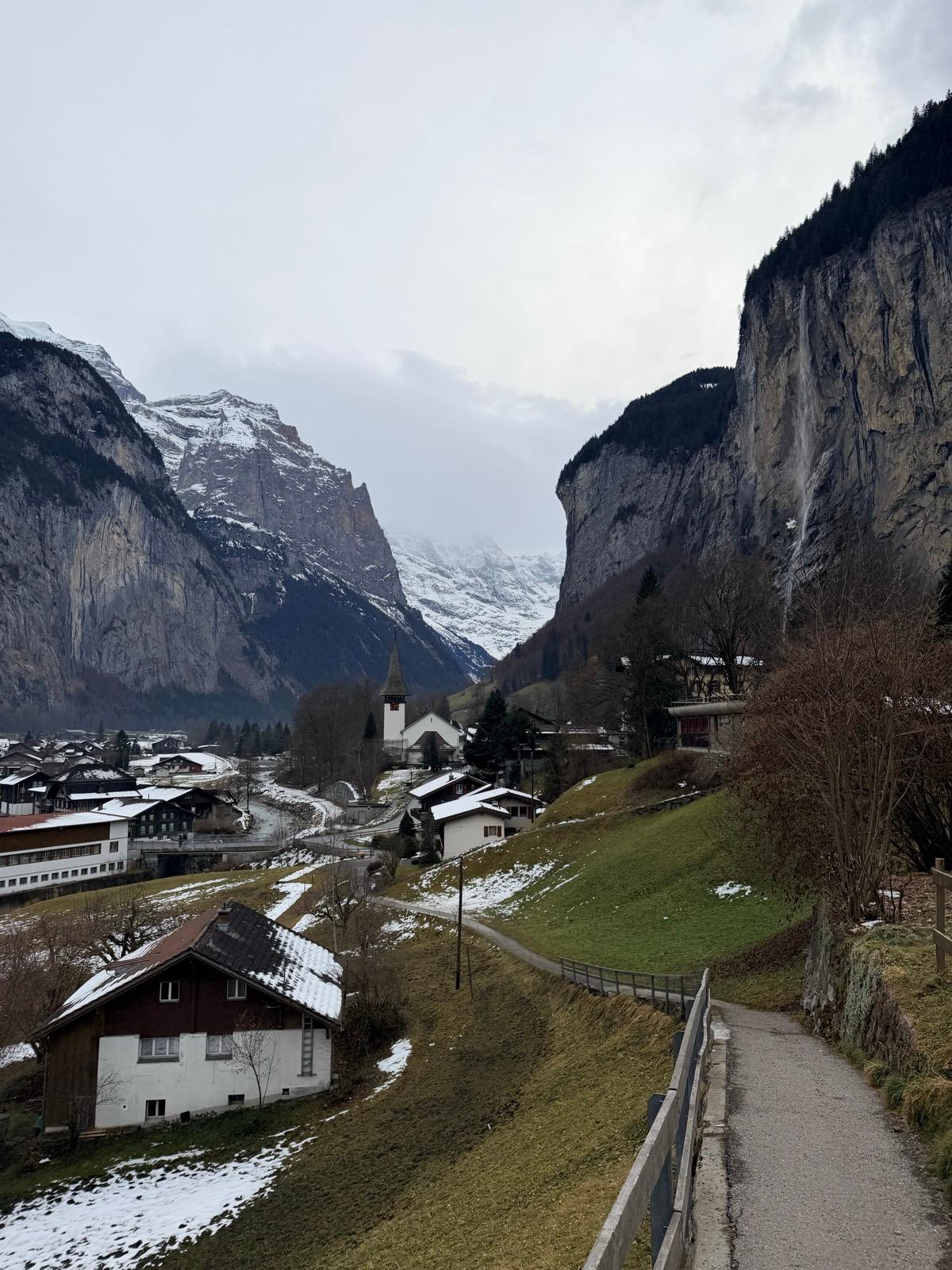
Lauterbrunnen is the other one, and it is the valley that every photograph of Switzerland is secretly trying to be. Sheer grey walls on both sides, a flat green floor with a village strung along it, and waterfalls coming off the cliff tops, including the Staubbach, which drops around 300 metres and turns to drifting spray long before it reaches the bottom. In December the cliffs were dark and wet, there was snow on the high ground at the head of the valley, the cloud was low enough to cut the peaks off, and the whole thing felt less like scenery and more like weather happening in a confined space.
Lauterbrunnen, cliffs and cloud
Bern, and a Market in Front of the Central Bank
We spent a day in Bern, which in December means Christmas markets, and the one that stuck with me was on Bundesplatz: rows of wooden chalets and an ice rink set up directly in front of the Swiss National Bank.
There is something very Swiss about this. The building is handsome, serious, institutional, the physical headquarters of one of the world's more consequential monetary authorities, and for a few weeks a year there is a temporary village of mulled-drink stalls parked on its doorstep with people skating in front of it. Nobody appears to find this strange.
Having written about Cologne and Strasbourg earlier in the year, I'll say the Swiss version is smaller and more restrained than the German and Alsatian ones. Fewer stalls, less scale, less of the fairground quality. Whether that is better depends entirely on what you want from a Christmas market. We liked it, though if the market is the main reason you are travelling, Cologne is the stronger trip.
For us the non-alcoholic question resolved itself easily enough: there is always hot chocolate, there is usually a non-alcoholic punch of some kind, and nobody has ever once cared what is in our cup.
Eating
This is the part where I'll be straightforward rather than useful.
We cooked most of our own meals. That is not a hardship story and it isn't a complaint about Swiss food, which is excellent at what it does. It is just the practical arithmetic of travelling as vegetarians in a region whose culinary identity is built on cheese, cured meat and rösti. Cheese is genuinely well represented, fondue and raclette are both naturally vegetarian, and in the larger towns you will find options without working for it. In a small mountain village on a December evening, you will work for it.
Cooking also solves the cost problem, which in Switzerland is real and which people under-warn you about. Self-catering turns Switzerland from an expensive country into a merely pricey one.
So: take the fondue, take the raclette, take the hot chocolate at every opportunity, and have a plan for the evenings when the one open kitchen in the village is serving three things and two of them have bacon in them.
Grindelwald, and Going Back
We finished at Grindelwald, which sits in a bowl with the Eiger on one side and chalets scattered up the slopes in a way that looks deliberately arranged and isn't. Our last morning there had the clearest light of the trip, a snow-covered peak catching the sun at the head of the valley, the village still in shadow, smoke going straight up from a few chimneys.
Five days is not long and we did it as a loop of day trips rather than a base-and-explore, which I'd do differently next time. The driving is easy and the trains are better, but the Oberland rewards staying put more than it rewards covering ground. We never got on a mountain railway. We never went up anything. We looked at the high country from below for five days and left.
Grindelwald, last morning
Which is the argument for going back, and probably in a different month. February or March, higher up, with a cable car ticket and no itinerary. The valleys were beautiful in a muted, grey-green, waterlogged way, and I suspect they are something else entirely when the snow comes down to meet you.
And I'd go and see the statue again. There is something genuinely moving about a Swiss town putting up a monument to an Indian filmmaker because he made their mountains famous in our living rooms. It is a small piece of mutual acknowledgement between two places that have nothing obvious in common, and it was the most unexpected thing we found.
Ambassador of Interlaken