Edinburgh - Stones, Weather, and a Bit of Magic
Edinburgh isn't a city I'd thought much about. We'd been to Scotland before, mostly the Highlands, but somehow the capital had stayed on the list without ever quite making it onto the calendar. So when four days in April opened up, my wife and I went, and this time it was Edinburgh.
What we found was a city that doesn't need a sales pitch. Edinburgh just is, in the way that only old cities can be. It lays its history out in stone and weather and lets you do the work of paying attention.
A City Carved in Stone
The first thing you notice is the weight of it. Stone everywhere, dark and damp from a recent rain, climbing up hills and down ravines. The Old Town runs along a ridge that drops on either side, with the Royal Mile as its spine, the Castle at one end and Holyrood Palace at the other. Once you understand that geometry, the whole city starts to make sense.
Walking the Royal Mile, you pass St Giles' Cathedral with its crown spire, the High Court, the Hub with its slender tower, and a dozen pubs that look like they've been pubs since pubs were invented. Spring bunting was strung between the buildings while we were there, which somehow made the gothic edges feel a little less serious without making them less grand.
What surprised me was how livable it all felt. Edinburgh doesn't perform for you. The Castle isn't a museum perched above the city, it's a hill you can see from almost everywhere and a building you can climb up to. The cathedrals are working churches. The closes, those narrow alleys cut between tenements, are real shortcuts that locals actually use. You're walking through history and someone's commute at the same time.
Old Town, in stone
Through the Closes
If you stay on the Royal Mile, you'll see Edinburgh. If you turn into the closes, you'll feel it.
The closes are these narrow stone passages, sometimes barely wide enough for two people, that cut between the buildings of the Old Town. Some are open at both ends and bring you out somewhere unexpected. Others lead to courtyards or staircases or someone's front door. Each one has a name (Advocate's Close, Brodie's Close, World's End Close) and a small story carved on a plaque somewhere.
We made it a small game to take every close we passed if we had the time. The payoff was rarely a destination. The payoff was the close itself: the way the stone closes in overhead, the cool damp air, the sliver of sky at the top, the quiet that fell as soon as you stepped off the main street. Edinburgh is one of those places where the spaces between buildings matter as much as the buildings themselves.
A Hill in Every Direction
The other thing about Edinburgh is that you can never quite forget where you are. From almost any street, you'll see a hill. Either the Castle Rock to the west, or Calton Hill to the east, or, if you turn south, the broad green back of Arthur's Seat. And eventually you give in and climb one.
We climbed Calton Hill on our second day. It's the easiest of the three, twenty minutes from Princes Street and you're standing among the strange collection of monuments at the top: Nelson's Monument, the Dugald Stewart Monument, and the unfinished National Monument, sometimes called Edinburgh's Disgrace, sometimes its Acropolis. It was meant to be a copy of the Parthenon, ran out of money halfway through, and has stood there as twelve grand columns and nothing else for nearly two hundred years. I have rarely seen a more honest piece of architecture.
The view from Calton Hill is, I think, the best in the city. You see the whole Old Town skyline laid out, the Castle on its rock, the spires of the churches, the bulk of Arthur's Seat in the distance. It was an overcast day with patches of blue, and the wind was sharp enough to make us pull our hoods up. The yellow gorse was in full bloom along the slopes. It felt like Scotland in a way the city below didn't quite.
From the hill
The Wizarding World, Hiding in Plain Sight
I want to be careful here, because I know how this can go. But the Harry Potter thread in Edinburgh isn't manufactured tourist bait. It's woven into the city, and even if you weren't planning to engage with it, you'd start noticing things.
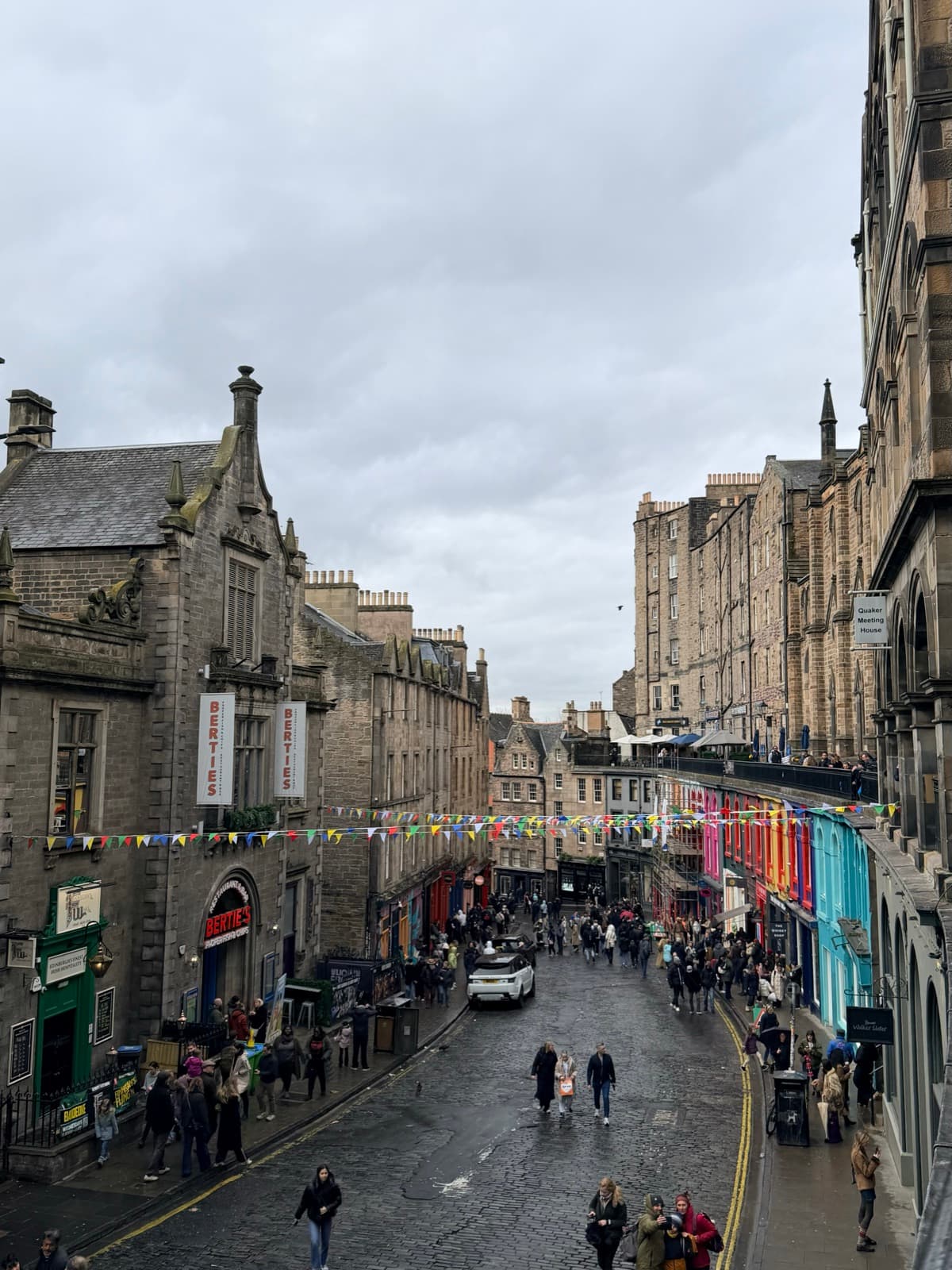
Victoria Street is the obvious one. The curved, cobbled, colorful street that runs from the Grassmarket up to George IV Bridge is widely said to have inspired Diagon Alley, and even if Rowling has never confirmed that directly, you can see why. The shopfronts are deep saturated reds and blues and greens, the cobbles tilt at funny angles, and the whole thing curves out of view in a way that feels like it's hiding something. It's busy with tourists, of course, but it's also just a beautiful street.
Greyfriars Kirkyard, a few minutes' walk away, is quieter and stranger. Among the gravestones you'll find names that ended up in the books: Thomas Riddell, William McGonagall, Elizabeth Moodie. Whether Rowling lifted them deliberately or whether they just sank into her subconscious from the years she spent walking past, the effect on a visitor is the same. The kirkyard is also home to the small statue of Greyfriars Bobby, the Skye terrier who supposedly guarded his owner's grave for fourteen years. Fresh flowers were piled at his headstone the day we visited.
And then there's the Elephant House. The cafe where Rowling wrote parts of the first book is still on George IV Bridge, painted bright red, still serving coffee and now butterbeer. We sat at the window with two of them, whipped cream on top, butterscotch syrup underneath, looking out at the flags of the street below. It was as cheesy as it sounds, and we loved it.
Diagon Alley energy
A Quieter Edinburgh
For every Royal Mile, there's a Dean Village. Twenty minutes' walk from Princes Street, down a steep hill and along the Water of Leith, and you find yourself in something that doesn't feel like the same city. Dean Village is a tiny pocket of red sandstone and yellow render, a millworkers' settlement that somehow survived into the 21st century with its character intact. Well Court, with its clock tower and crow-stepped gables, is the postcard shot. But the whole place is worth the wander.
Stockbridge, just up the river, is what Edinburgh feels like when it relaxes. Independent shops, good cafes, a Sunday market, Georgian terraces that haven't yet been polished into hotels. We didn't stay long, but it was the kind of neighborhood you make a note to come back to.
There's a version of Edinburgh that lives entirely in the Old Town. The Castle, the Mile, Victoria Street, Greyfriars. It's a great version. But there's also a version that lives in the closes and the river paths and the corners where the wind doesn't quite reach, and that's the one I think we'll remember longest.
Quiet corners
Four Days, A Lasting Impression
Four days isn't a lot of time. We didn't make it to Arthur's Seat. We didn't see Leith. We didn't go inside the Castle, or the National Museum, or any of the dozen other things people will tell you you should have done. But we walked a lot, and we drank a lot of coffee, and we let the weather decide our pace.
What stayed with me is how layered Edinburgh felt. Not just the obvious layers (Old Town and New Town, medieval and Georgian, tourist and local) but the way each of those layers seemed to know about the others and lean into them rather than compete. The city doesn't pretend to be one thing. It's a fortress town and a university city and a literary capital and a tourist set piece all at once, and somehow it doesn't feel confused about that.
We'll go back. Probably in summer, maybe for the Fringe, maybe just to climb the hill we missed. Edinburgh isn't a city that gives itself up in one visit, and I'm glad. The closes are still there, the gorse is still blooming somewhere, and there's a butterbeer with our name on it.