- Published on
The 48-Team Experiment: Format, Rules, and the Price of the 2026 World Cup
- Authors

The first 48-team World Cup has cleared its group stage, and the football has been good enough to talk about on its own terms. I will get to that in the next post. Before that, though, this tournament is worth pausing on for a different reason: almost everything around the football has changed at once. A bigger format, a longer schedule, a new rulebook, mandatory drinks breaks in every match, and a ticket-pricing experiment that FIFA spent the last month quietly walking back.
Some of it is sensible. Some of it has divided opinion sharply. And some of it, frankly, looks like an own goal. This is a tour through the 2026 World Cup off the pitch, before we get to what happened on it.
Table of contents
- The 48-team experiment
- A new rulebook
- The smart ball
- Hydration breaks: the great divider
- The price of a ticket
- The verdict so far
The 48-team experiment
This is the headline change, and it is a big one. The World Cup has gone from 32 teams to 48, spread across three host nations - the United States, Canada, and Mexico - and 16 host cities. The old, familiar shape of eight groups of four is gone. In its place are 12 groups of four, and a new knockout round that did not exist before.
Here is the structure at a glance:
| Element | Old format (2022) | New format (2026) |
|---|---|---|
| Teams | 32 | 48 |
| Groups | 8 groups of 4 | 12 groups of 4 |
| Who advances | Top 2 per group | Top 2 + 8 best 3rd place |
| First knockout | Round of 16 | Round of 32 |
| Total matches | 64 | 104 |
| Host nations | 1 | 3 |
The mechanics of qualification are where it gets awkward. Twelve group winners and twelve runners-up account for 24 of the 32 knockout places. The remaining eight go to the best third-placed teams across all twelve groups. That last part is the source of most of the complaints. For long stretches of the final group games, no one - not the players, not the coaches, sometimes not even the broadcasters - could tell you with certainty whether a third-placed side was through, because it depended on results in five other groups being played at the same time.
It made for some strange incentives. A few teams spent the closing minutes of dead-rubber-looking games chasing a goal that turned out to matter enormously for third-place tiebreakers. It also, unavoidably, produced a group stage where a fair number of teams could lose a game, or even two, and still progress. Whether that is a feature or a bug depends on what you want the World Cup to be. More teams means more nations get their moment, and this tournament delivered a few genuine debutants and fairy tales. It also means more games that do not carry the old, brutal, win-or-go-home weight from the first whistle.
104 matches is a lot of football. That is the trade. You get more of the thing you love, and each individual serving is slightly less concentrated.
A new rulebook
Alongside the new format came the most substantial batch of law changes in years, most of them aimed squarely at time-wasting and the slow death of the ball being in play. Several of them showed up on screen almost immediately.
The one everyone noticed is the goalkeeper rule. A keeper who holds the ball in their hands for more than eight seconds now concedes a corner to the opposition. This replaces the old six-second rule, which awarded an indirect free kick and was enforced roughly never. The difference this time is the punishment and the theatre: with five seconds gone, the referee raises an arm and visibly counts down from five on their fingers. It has already caught a few keepers out, and it has very clearly changed how long they dare to sit on the ball.
The rest of the anti-time-wasting package works on the same logic:
| Situation | New rule |
|---|---|
| Goalkeeper holding | More than 8 seconds concedes a corner (was 6 seconds, indirect free kick) |
| Throw-ins | Fail to release within 5 seconds of being ready and possession switches |
| Goal kicks | Not taken within 5 seconds and the opponent is awarded a corner |
| Substitutions | Replaced player has 10 seconds to leave once the board goes up |
Then there is VAR, which has been given a slightly wider remit. It can now intervene on a corner that was awarded in error and led directly to a goal - the long-requested fix for the "wrong corner" problem, where a goal is scored from a set piece that should never have been given. It can also step in on clearer cases of mistaken identity, and on a red card that came from an obviously incorrect second yellow. None of this makes VAR loved. It does close a few of the more maddening loopholes.
The through-line is obvious. FIFA wants the ball in play more, and dead time punished. On that narrow measure, the early evidence is that it is working. Keepers are quicker, restarts are quicker, and the theatrical countdowns have added a small, faintly ridiculous new tension to goal kicks.
The smart ball
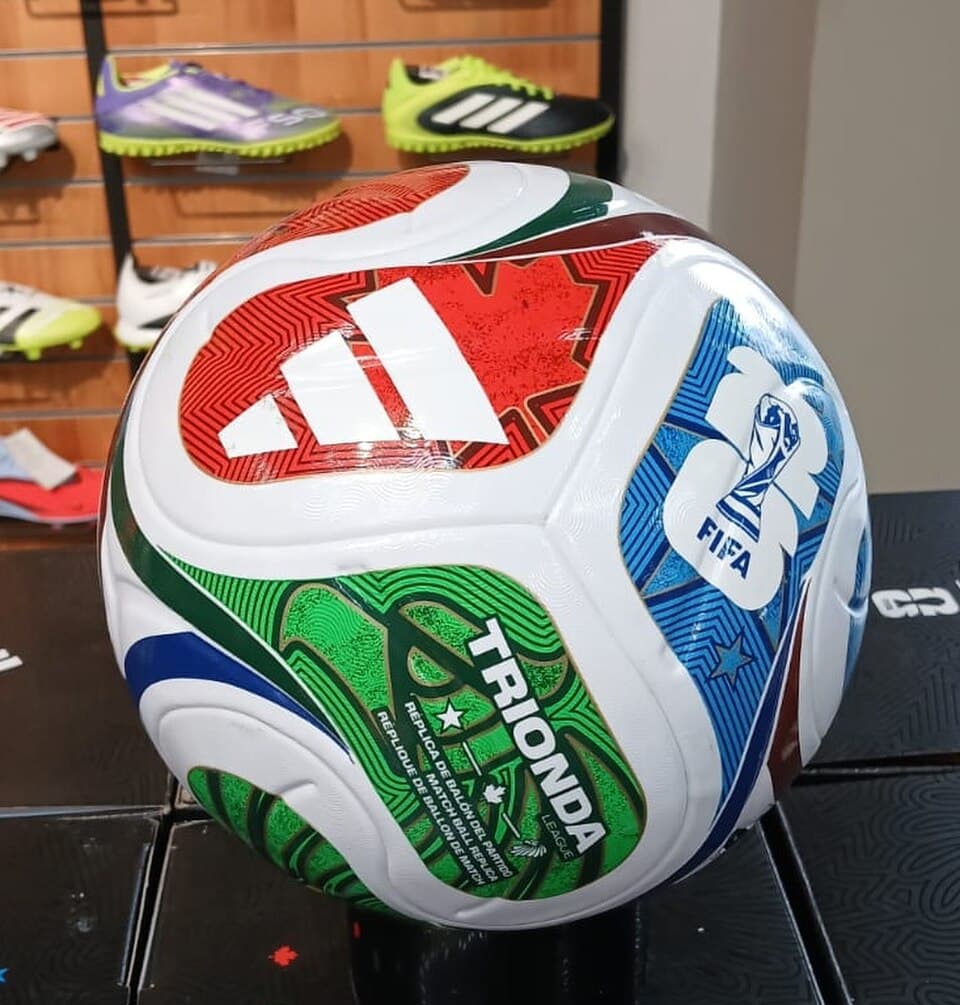
The official ball, the Adidas Trionda, is worth a mention because it is not just a ball. Its name nods to the three host nations, its four-panel design carries a maple leaf, an eagle, and a star for Canada, Mexico, and the United States, and it uses the smallest number of panels of any World Cup ball to date.
The part that actually matters sits inside it. The Trionda carries a 500Hz motion sensor that feeds precise ball-tracking data to the VAR system in real time. In practice, that means the technology can tell, to a level of precision the human eye cannot, the exact moment the ball is touched. Paired with semi-automated offside, it takes a lot of the guesswork out of the tightest offside and handball calls. It is the least glamorous piece of technology at the tournament and quite possibly the most consequential.
Hydration breaks: the great divider
If the rule changes have been broadly accepted, the hydration breaks have not.
Here is the rule. Every match - all 104 of them - pauses twice, once in each half, at roughly the 22nd and 67th minute, for a three-minute break. This is not weather-dependent. It happens in the desert heat of a midday game in Texas and it happens under a closed roof in temperate Seattle. FIFA's stated reasoning is player welfare: a summer tournament, played across a continent in genuinely dangerous heat and humidity, needed a guaranteed way for players to rehydrate and cool down, and making it universal keeps conditions equal across every game.
The medical case is real. Nobody seriously disputes that a July afternoon in some of these host cities is a health risk for players running for 90 minutes. The player unions have wanted something like this for a while.
The football case against it is also real, and it is what most fans and coaches keep coming back to:
- It breaks momentum. A team that has spent twenty minutes building pressure gets stopped dead, and the game restarts flat.
- It has quietly turned football into a four-quarter game. Coaches now get two extra huddles per match to reset tactics and instructions, which changes the rhythm and the coaching dynamic in a way some managers openly dislike.
- The universal, weather-blind application is the part that annoys people most. A three-minute stop for hydration during a cool, roofed, evening game is a hard sell as a medical necessity, which has led to the unavoidable suspicion that these are as much commercial breaks as cooling breaks.
My own read, for what it is worth, is that the principle is right and the blanket application is wrong. Protecting players in real heat is not negotiable. Stopping a temperate indoor match twice for reasons that look more like ad inventory than medicine is what has soured the whole idea for a lot of people. The breaks have divided opinion, and the split is roughly: doctors and player unions in favour, most fans and a good number of coaches against.
The price of a ticket
And then there is the ticketing, which is the part of this World Cup that went from ambitious to embarrassing.
FIFA used dynamic pricing for the first time at a men's World Cup - the same demand-based model airlines and concert promoters use, where the price moves with demand rather than being fixed. In theory it captures the true market value of a seat. In practice, at a tournament this size and this scrutinised, it produced numbers that were hard to defend.
The gap between promise and reality is the story:
| Ticket | Figure |
|---|---|
| Final, original bid promise | $1,550 maximum |
| Final, standard seats in 2026 | roughly 33,000 |
| Final, hospitality packages | up to around $73,000 |
| Resale marketplace listings | into six figures, some over $2M |
When the US, Canada, and Mexico put together the original bid to host, they said a seat at the final would cost at most $1,550. By the time the tournament arrived, the cheapest standard final tickets were multiples of that, top categories ran into the tens of thousands, and FIFA's own resale marketplace - on which it takes a cut of every transaction - had listings running into six and even seven figures.
It drew the kind of attention FIFA did not want. The attorneys general of New York and New Jersey issued a subpoena over the pricing process, noting that prices had far exceeded any previous World Cup. And then came the quiet climbdown. At the start of June, FIFA slashed prices across all 104 matches, and reportedly returned around 70 percent of its block-booked hotel rooms as demand failed to materialise. Two days before the opening game, there were reports of roughly 180,000 unsold tickets.
That is the awkward truth underneath the sticker shock: for all the talk of unprecedented demand, a lot of seats did not sell at the prices FIFA set, and it had to blink. A demand-based model only works if you read the demand correctly. FIFA read it wrong, in public, and spent the last month before kickoff correcting course.
The verdict so far
Strip it all back and the 2026 World Cup off the pitch is a mixed report card. The rule changes are mostly good, or at least defensible, and they are visibly doing what they set out to do. The smart ball is quietly excellent. The 48-team format is a genuine trade rather than a clear win - more nations and more football, at the cost of some of the old jeopardy and a group stage whose maths needed a spreadsheet to follow. The hydration breaks got the principle right and the execution wrong. And the ticketing was a self-inflicted wound that FIFA is lucky the football has been good enough to distract from.
Because the football has, in fact, been very good. Some of the favourites have looked the part, a couple of giants have already gone home, and the new format has thrown up exactly the kind of upsets it was designed to enable. That is the next post.